Helicopter Parenting: The Long-Term Effects and Consequences
“How to begin to educate a child. First rule: leave him alone. Second rule: leave him alone. Third rule: leave him alone. That is the whole beginning.” – D.H. Lawrence
What Is a Helicopter Parent?
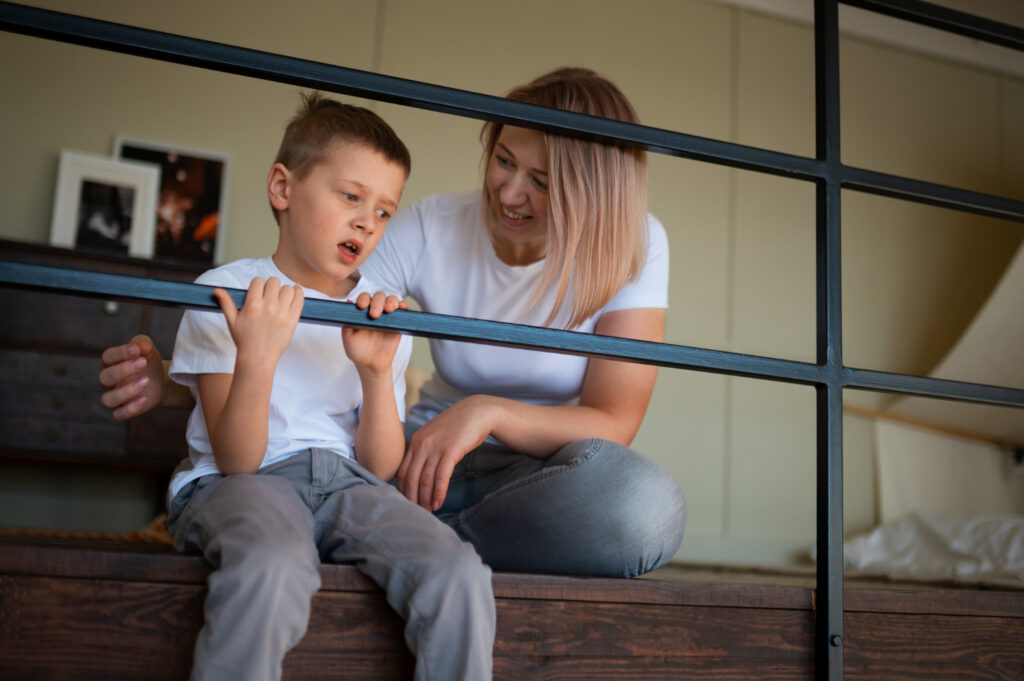
Helicopter parenting means being involved in a child’s life in a way that is overcontrolling, overprotecting, and overperfecting. This parenting style involves staying very close, rarely out of reach, paying extremely close attention to your child and rushing in to prevent any harm, both physical and psychological, often in the name of love and protection.
In practice, helicopter parents may blur personal boundaries, creating an enmeshment where sub-systems become undifferentiated and over-concern leads to a loss of autonomous development. Research on helicopter parenting effects consistently shows that this form of overprotective parenting can interfere with healthy child development, independence, and self-efficacy, particularly as children grow older and are expected to manage challenges on their own (Schiffrin et al., 2014).
If you thought helicopter parents were too much, wait until you learn about Lawnmower Parents. These are often described as the next generation of helicopter parents who take over parenting to an even more extreme level.
Rather than hovering, these parents actively prepare the way for their children to succeed by removing every obstacle in their child’s path, ensuring their children always look perfect and stepping in immediately to fix anything that does not go to plan. This approach represents a more intensified form of over parenting and highlights how the negative effects of helicopter parenting can escalate.
Am I a Helicopter Parent? Key Characteristics
However, if most parents read this, they will likely say, “Phew, that is not me.” So let’s look at some common signs of helicopter parenting:
- You prevent your child from exploring or stretching their abilities (e.g. stopping climbing, risk-taking, or independent play).
- In toddlerhood, you constantly shadow and direct behaviour, leaving little space for autonomy.
- In elementary school, you select teachers, coaches, friends, or activities.
- You closely monitor homework and school projects or provide disproportionate help.
- You shield your child from failure or intervene to “fix” outcomes.
- You do tasks your child is capable of doing themselves.
- You influence choices based on your own ambitions.
- You negotiate conflicts on your child’s behalf.
- You train coaches, tutors, or teachers “for” your child.
- You manage responsibilities that should gradually belong to them.
- You limit age-appropriate decision-making.
The issue is rarely whether parents help—but how often, how quickly, and to what degree. Occasional guidance is healthy. Constant monitoring and intervention are not. Research shows that children interpret excessive involvement as a lack of trust in their competence (Aznar, 2024; Schiffrin et al., 2014).

Long-Term Consequences or How Does Helicopter Parenting Affect a Child?
The effects of helicopter parenting often emerge gradually. While short-term gains may be visible, the long-term consequences are substantial and well-documented in psychological research.
1. Underdevelopment of the Brain
Helicopter parenting implicitly involves parents taking decisions for their children, reducing their need to problem solve and make their own decisions. The area of the brain that deals with these components is housed in the prefrontal part of the brain, which is responsible for executive functions such as planning, judgement, impulse control, and decision-making. This part of the brain is found to only be fully developed at around 25 years of age, but it functions much like a muscle and requires regular use to mature effectively.
The brain is exercised by “doing,” meaning by doing it yourself, failing and falling, and learning how to do it better next time. This process increases the connectivity and effectiveness of the prefrontal cortex. Having helicopter parents may hinder a child’s ability to develop problem-solving and decision-making skills, which are essential for independence and resilience. Studies grounded in self-determination theory show that reduced autonomy is linked to lower competence and wellbeing later in life (Schiffrin et al., 2014).
2. Emotional Backlash and Poor Self-Regulation
If parents exert too much control and step in before children attempt to handle challenges on their own, or physically keep children away from challenging contexts altogether, they may hinder the development of self-regulatory abilities. Emotional regulation is closely linked to prefrontal brain development, as this region helps modulate emotional responses and stress.
This is a well-researched area. A study published in Developmental Psychology found that young children exposed to highly controlling parenting were less able to regulate emotions and behaviour by early childhood, increasing the risk of emotional problems later on. These findings reinforce why you need to help your teenager learn from failure, and they help explain how helicopter parenting affects a child’s emotional development well beyond early childhood.
3. Low Self-Esteem and Confidence
Helicopter parenting often backfires. The over-involvement of a parent can communicate to a child that they are not trusted to act independently, which undermines self-esteem and confidence. Over time, children may come to believe that competence lies outside of themselves rather than within.
When we parent this way, we deprive children of opportunities to be creative, to problem solve, to develop coping skills, to build resilience, and to discover what makes them happy and who they are. Although parents may over-involve themselves to protect their child and achieve short-term success, the underlying message received is often, “You cannot do this without me.” Research from the Gottman Institute and others links this pattern to fear of failure and reduced autonomy in adolescence and adulthood.
4. Immature Coping Skills and Low Frustration Tolerance
When parents are always present to prevent problems or clean up messes, children are denied opportunities to learn through failure, disappointment, and loss, which are inevitable aspects of life. Meaningful consequences play a crucial role in developing emotional intelligence and adaptive coping strategies.
When otherwise healthy but overparented young people reach university or early adulthood, they may struggle with everyday challenges such as navigating conflict with roommates, receiving ambiguous feedback from teachers or supervisors, or managing changing social relationships. Research on emerging adults shows that helicopter parenting is associated with poorer decision-making skills, increased anxiety, and difficulty coping with uncertainty (Hwang et al., 2022).
This inability to sit with discomfort, evaluate options, and make independent decisions can become a problem in itself. As a result, overprotection makes it difficult for young people to develop problem-solving skills and frustration tolerance, placing them at a disadvantage when they enter the workforce.
5. Mental Health Problems
Helicopter parenting has been consistently linked to higher levels of anxiety and depression in children, adolescents, and young adults. Children raised in this way often remain on the lookout for guidance and reassurance, and when left alone to decide for themselves, they may feel overwhelmed and fearful.
A growing body of research shows that children of overbearing parents are more vulnerable to internalising problems and, in some cases, more likely to require medication for anxiety or depression during university years (Schiffrin et al., 2014; Segrin et al., 2012). These findings underscore the long-term impact of helicopter parenting on mental health. Ultimately, while parents aim to raise happy children, excessive control can undermine a child’s ability to develop a stable sense of self, which is essential for long-term wellbeing.
6. Sense of Entitlement
When parents involve themselves extensively in their child’s academic, social, and athletic lives, children may become accustomed to having their needs anticipated and fulfilled by others. Over time, this can foster a sense of entitlement rather than responsibility or reciprocity.
A large-scale family study found that overparenting was a significant predictor of entitlement in young adult children, without corresponding increases in adaptive traits such as independence or resilience (Segrin et al., 2012). This highlights a key relational cost of helicopter parenting.
7. Meanness and Aggression
Research suggests that children raised by intrusive helicopter parents may display higher levels of hostility or aggression toward peers. This behaviour is often understood as a response to extreme parental control and a lack of personal agency.
In such cases, children may act out or attempt to dominate social situations as a way to reclaim control over their own lives. These patterns further illustrate the negative effects of helicopter parenting on relationships and social development.
How Does the Helicopter Parenting Style Come About?
Fear for Our Children
The standard of overparenting, more commonly known as helicopter parenting, is a few decades in the making and is largely derived from a cocktail of dread. This includes fear that our children might be injured or kidnapped, anxiety that they might not be academically or socially successful without constant supervision, and worry that not tending to a child’s every need will somehow lead to irreparable psychological damage.
As a remedy, some parents have embraced intensive and overprotective parenting styles that are endlessly caricatured, yet have nonetheless shifted the collective expectation of what it means to be a responsible and devoted parent. Research from the Clay Center for Young Healthy Minds highlights how fear driven parenting styles are closely linked to rising anxiety, perfectionism, and the long term effects of helicopter parenting on child development.
Comfortable Financial Situations
A variety of factors shape the ability to provide such an involved and attached level of parenting, and finances are among the most important. Helicopter parents are more commonly found in families with greater financial flexibility, where time, resources, and access make constant involvement more feasible.
Money may not buy happiness, but it creates space and time, including in some cases the option for one parent to stay home. Research suggests this can unintentionally reinforce over parenting, allowing parents to become deeply involved in their child’s academic, social, and emotional lives in ways that blur boundaries.
Research also reveals an interesting self perpetuating cycle. Professional women who leave work to prioritise parenthood may justify that decision by making child rearing a full time and all encompassing job, which in turn raises the stakes of what ideal parenting looks like. In the age of social media, visibility offers both support and judgement, with parents increasingly comparing themselves to helicopter parenting examples they encounter online.
Social Media Pressures
Social media has significantly upped the ante and intensified helicopter parenting effects. Many parents feel pressure to make their children appear as successful as possible in the eyes of online audiences, turning parenting into a race to accumulate achievements, awards, and experiences on behalf of a child.
Because of this competitive environment, parents fear their children will fail or fall behind, leading them to step in and manage their children’s problems directly. For this reason, children’s schedules often become filled from an early age with extracurricular activities that are justified as preparation for adult life, despite growing concern about how helicopter parenting affects a child’s wellbeing and autonomy.
Only Child
There are many other reasons for this parenting style. Children may be perceived as material property of great value, particularly in families where children are born later in life or after fertility treatments. In these cases, children can become exceptionally protected, increasing the likelihood of overprotective parenting.
Parents may also fear being seen as emotionally distant, leading them to overcompensate by being excessively present. This pattern is frequently observed in helicopter parenting and contributes to blurred boundaries within the parent child relationship.
And More…
Another reason lies in what parents believe is expected of them. If a child loses a ball in the water, rather than allowing the child to problem solve, a parent may intervene out of fear of being judged as negligent. This social pressure often reinforces helicopter parents’ behaviours, even when parents are aware of the downsides.
For many parents, over parenting becomes a reflection of how well they believe they have performed as parents. This is especially true in later school years, when one principal observed that college admissions often feel like a report card on parenting success. Research by Segrin et al. supports this observation, showing that helicopter parenting effects include poorer parent child communication and increased entitlement, without corresponding gains in adaptive skills.
Each one of us will intuitively recognise our own reasons if we sit with this question long enough. Regardless of the cause, for the health and wellbeing of our children and their future relationships, there is growing evidence that moving away from this parenting style is essential.

How Not To Become A ‘Helicopter Parent’
Always, always, think of the long-term goal, not the now. What is it I want my child to achieve? Can he achieve it with my interference, or am I engaging in overprotective parenting that may limit independence?
- A child is stuck on a homework problem and you help them by giving them the solution. The long-term goal is that they become their own problem solvers, which is essential for healthy child development. So, this is an example of what not to do when trying to avoid the negative effects of helicopter parenting. What you can do instead is suggest ways of thinking about the problem or nudge them to research the answer to the problem, supporting learning without becoming a helicopter parent.
- A child comes home after having a fight with a friend. The long-term goal is for them to learn to be flexible in their thinking and come up with potential solutions, rather than relying on helicopter parents to intervene. Telling them what to tell their friend would not be the answer and is a common helicopter parenting example. However, by listening carefully and hearing them out as they track through the possible solutions is the right thing to do to achieve the long-term goal and support a healthy parenting style.
Remember to think, “What am I implicitly telling my child?” Our children take away the underlying message, not the actual words, and this is central to understanding how helicopter parenting affects a child.
Remember their brains grow by letting them do. If we always pick up what is on the floor, what they drop, then the physicality of checking and reaching to pick up does not wire, and they will be hard pressed to become neat as they grow. This is one of the lesser-discussed helicopter parenting effects on everyday skill-building. If I pick up my child’s jumper when we leave the waiting room, what am I implicitly teaching my child? Well, that others will do the work for him, reinforcing patterns seen in over parenting and limiting responsibility.
If I keep checking my child’s work each time he does his homework, what am I implicitly telling my child? Well, “you need to rely on others to do a good job because on your own you might not do it well enough,” which mirrors the effects of helicopter parenting on confidence and self-efficacy.
Ask, “Whose problem is this?” If these really are kid problems, then our job is not to solve them. It’s to help the kid solve them, which is key to avoiding the long-term impact on child development associated with helicopter parenting.
Research on rats shows that when you shock them, it’s extremely stressful. But if you give them a wheel to turn after, it gives the rat a sense of control and the prefrontal cortex activates. Then, in similar stressful situations, the rat can leap into a coping mode, even in situations that are uncontrollable. What we want to do is condition kids, when they have a problem, to leap into coping mode rather than waiting for their parent or someone else later in life to solve the problem, as often happens with helicopter parenting.
The latter can again lead to learned helplessness, anxiety, and depression, which are well-documented effects of helicopter parenting. There are some problems a kid can’t solve themselves. If they’re being mercilessly bullied at school, an adult needs to step in. But we want, as much as possible, for kids to develop that coping impulse. It almost inoculates kids from stress by experiencing that. There’s a big difference between coaching a kid and trying to solve problems for them, and understanding that difference is key for any parent concerned about the negative effects of helicopter parenting.
How Can Parents Give Up Control Without Checking Out Completely?
When kids feel securely attached to a parent or caregiver, they feel safe, and when they feel safe, they explore and take risks appropriately. They’re more adventurous, which is essential for healthy child development and emotional growth. Having the internal sense of safety, or a “safe base,” is simply good for human beings and helps counter the negative effects of helicopter parenting.
In one study, researchers separated baby rats from their mothers every day for a couple of weeks, which was extremely stressful for the rats, and then brought them back to their mothers. When mothers licked and groomed them for a long time after and let them know they were okay, these rats became almost impossible to stress as adults. But you have to have that den, that environment to let your guard down, something that overprotective parenting can unintentionally interfere with.
- Stop saying “we”! I catch parents saying this a lot: “we need to go home to do homework.” Huh, no, it should be “we need to go home so you can do homework.” I hear “we didn’t do so well on that test.” Hum? Whose test is it? This language shift matters when reducing helicopter parenting habits.
- Stop arguing with adults in your kid’s life. Let them do the problem solving, but you can guide them. This supports independence and reduces reliance often seen in helicopter parents.
- Stop doing their homework! Stop checking their homework! Parents seem to find this the hardest. When this is stopped from a young age, kids will learn to self-monitor, a skill often delayed by over parenting. Don’t worry, the negative consequence of looking bad before their teacher and peers will mostly motivate them to do their homework. When they are coached through homework and suddenly at 12 years old they are expected to do it on their own, this becomes a terrifying chore with no internal self-regulation.
- Stop solving your kids’ problems!! Ask them, “well what do you think you should do?” Ok, go try it out and then tell me how it went. Do not give them the answers. Let them trial and fail and trial and succeed. This directly addresses how helicopter parenting affects a child’s coping skills and confidence. Do you know how much effort and energy parents put into trying to find solutions or giving the answers? I am sure you know!
- We need to stop over-scheduling our kids and let them play outdoors on their own, without adult supervision or control. We need to trust our kids and recognize that they’re smart, resourceful young people, better able to care for themselves than we might imagine. When our kids can spend time just playing and hanging out with one another, they’ll learn essential life skills including leadership, cooperation, problem-solving, flexibility and compassion, all of which are often weakened by helicopter parenting effects.
- Keep in mind a good motto: “Our job as parents is to put ourselves out of job!!” This mindset helps prevent the long-term effects of helicopter parenting while still parenting from love.
Let Them Fall!
The main message here is clear and bears overwhelming importance: LET THEM FALL. Oh I can hear it already “What! that is totally irresponsible and dangerous”. Hear me out….. Yes let them fall……but…this is the image you need to keep in your mind: Your child is a tight rope walker in a circus (life), his aim is to walk that tight rope as safely as possible and get through the walk with his head held high, a sense of accomplishment, joy and unscathed as much as possible. This metaphor captures one of the most important lessons about helicopter parenting and its long term effects on child development.
So, if you hold your child’s hand as they try and walk that rope, what happens? Well, they will do quite well, they might wobble a little, they will get through it….but….will they learn it for themselves? What happens in this situation? Well, they won’t have made the neurological pathways to be able to sustain themselves on that rope, their brain will not have grown in those areas and they will fall, hard on to the ground. This is one of the clearest examples of how helicopter parenting affects a child, where overprotective parenting and constant intervention limit independence, resilience, and healthy problem solving.
But Be The Net.
Now, if you are not the hand holder but are the net, what happens? Your child will get up there with fear in their hearts, sweating profusely, knees like jelly but at some point they will get the courage to start that walk as they know that if they fall the net is there, you are there to catch them. This is where healthy support differs from overprotective parenting and helps prevent the negative effects of helicopter parenting. And they WILL fall, no doubt about that, many times. But what happens?? Well, they gain the confidence in themselves that bit by bit they can maneuver this challenge better, they gain the confidence that they can do it themselves but have someone there to not make the fall too hard when it goes wrong, rather than stepping in too early like many helicopter parents.
Slowly slow, the fear subsides, the sweating subsides, the wobbly knees dissipate and they start walking straighter, they start walking with confidence, they start smiling, they are sturdy, they are happy and they know in their gut and in their heart beyond a shadow of a doubt that I CAN DO IT on my own. This confidence is often missing when we look at the helicopter parenting effects described in research on how helicopter parenting affects a child. Now when they leave your nest at whatever age it may be YOU too will know in your heart of hearts that YOUR child can make it in this world with or without you and that my dear parent is something worth striving for!
Frequently Asked Questions
What is the opposite of helicopter parenting?
The opposite is authoritative or autonomy-supportive parenting, which balances warmth with independence and age-appropriate responsibility.
When did helicopter parenting start?
The term emerged in the late 1980s and gained popularity in the 1990s, particularly in discussions around education and college admissions.
Is helicopter parenting authoritarian?
It overlaps with authoritarian parenting but is typically driven more by anxiety and fear than discipline or control.
Is helicopter parenting always harmful?
Occasional support is healthy, but chronic over-involvement and control are linked to negative developmental outcomes.
Where did helicopter parenting come from?
It developed alongside rising academic pressure, competitive education systems, and social comparison.
How can parents reduce helicopter parenting habits?
By pausing before intervening, coaching rather than solving, and allowing age-appropriate failure.
When should parents seek professional help?
If anxiety or control feels overwhelming or is affecting family relationships, parent coaching or therapy can be helpful.